
Overview
The goal of the second degree is to deepen your practice of druidry. This includes cultivating an understanding about how our actions affect the Earth’s cycles, learning how to rebuild human-nature connections, and learning how humans can be a force of healing and good in relationship to the living earth. The Second Degree can be completed in a minimum of two years; however, you are welcome to take as much time as you need to complete it.
AODA Second Degree Curriculum
The following study program has been adopted by the Grand Grove of AODA for all members effective December 21, 2024. We see our curriculum as an evolving document—the Grand Grove reviews the curriculum every 7 years or as needed and adapts it based on the needs of our members. If you started on an earlier version of the AODA’s curriculum you are welcome to continue to work on that version of the curriculum (see our archive here of both previous versions of the Apprentice curriculum). However, if you have joined since December 21, 2024, we ask that you do the current curriculum as it is presented here. Please note: the curriculum given in The Druidry Handbook is the original curriculum (used from 2003-2012).
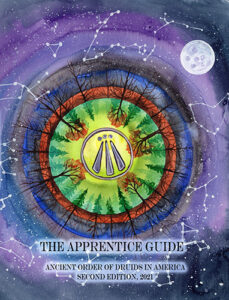
All AODA Apprentices are given a printed and digital copy of our AODA Apprentice Guide which provides a detailed overview and support for the Second Degree Studies. We also offer regular membership calls with Apprentices to support their path. We offer a Second Degree Checklist in MS Word Format or PDF format.
Expansion and Continuation of the First Degree Paths
As the first degree is the foundation of the second, the essential work of the second degree includes a continuation of the fundamental practices you learned in the first: the earth path, sun path, and moon path. Thus, you should continue your weekly time in nature, and pursue additional steps to make your life impose fewer burdens on the Earth’s biosphere; you should continue to celebrate a cycle of seasonal rituals, including the solstices and equinoxes, along with any other festivals you find appropriate; and you should continue to practice meditation, preferably discursive meditation, and the Sphere of Protection ritual on a daily basis. These should be continued throughout the minimum of two years you spend as an Apprentice, in preparation for initiation as a Companion. Additionally, we ask that you deepen your foundation in the following ways:
- Expansion of the earth path to explore reciprocal relationships between humans and nature: Part of the expansion of the earth path is done through the Core Curriculum in Druid Philosophy, where you explore nature-human connections in three directions. Being guided by those books and your growing awareness of human-nature relationships, we ask that you do one or more things that help continue to bring your relationship with nature into balance. This may include more earth path changes, work in conservation, nature education, planting trees or helping to protect ecosystems.
- Expansion of the sun path: Design an original set of activities for a yearly cycle of druid holy days, drawing symbolism and themes from any appropriate source; the ecology and natural history of the area in which you live are particularly recommended.
- Those activities may be artistic or musical if you are pursuing initiation as a Bard; scientific or environmental if you are pursuing initiation as an Ovate; or ceremonial, spiritual, or magical, if you are pursuing initiation as a Druid.
- Expansion of the moon path:
- Continue to practice meditation, and if you haven’t yet learned discursive meditation, take up this practice in the second degree.
- Adapt the Sphere of Protection to your own setting/ecology/spiritual practice (if you haven’t yet done so, the Apprentice Guide offers suggestions for how to do this).
- Study and practice the AODA Solitary Grove opening and closing ceremony. You should plan on performing this ceremony at least once a month for at least the minimum period of two years you spend preparing for the second-degree initiation. In the process, you should explore its uses as a framework for other activities, including those of your bardic, ovate, and/or druid path.
- Bardic, ovate, and/or druid personal spiritual practice:
- Establish a personal practice as a Bard, Ovate, and/or Druid. This may include, for example, taking lessons and engaging in a regular practice of a musical instrument as a Bard, pursuing ongoing ecological study or citizen science as an Ovate, or practicing a particular system of druid magic as a Druid. Consult the Apprentice Guide for a thorough discussion of this practice.
Core Curriculum in Druid Philosophy
Your preparation for the Companion degree will include a close study of the following seven books, which will provide you with seven distinct perspectives on the underlying ideas of druid philosophy and their expression in AODA. Please note that for the book list below, any edition is acceptable.
A Triad of Ecology and Human-Nature Connections
First, we ask you to read three books that help you deepen your understanding of ecology and human-nature connections. The philosophies and ideas contained in these books help you deepen your relationship to the living earth and better understand the interrelationships between nature and humanity.
Book 1: Read a book that helps you better understand how to live within the Earth’s cycles, regenerate the land, and be a force for good. Choose one of the following books or propose a book that aligns with this goal.
-
- Any setting:
- Greer, J. M. . Green Wizardry: Conservation, Solar Power, Organic Gardening, and Other Hands-On Skills from the Appropriate Tech Toolkit. (New Society Publishers, 2013).
- Morrow, R. . Earth User’s Guide to Permaculture. (Permanent Publications, 2006).
- O’Driscoll, D. Sacred Actions: Living the Wheel of the Year through Earth-Centered Sustainable Practices. (Schiffer/RED Feather Books, 2021).
- Urban settings: Toensmeier, E., & Bates, J. Paradise Lot: Two Plant Geeks, One-tenth of an Acre, and the Making of an Edible Garden Oasis in the City. (Chelsea Green Publishing, 2013).
- Suburban or rural settings: Hemenway, T. (2009). Gaia’s Garden: A Guide to Home-scale Permaculture. Chelsea Green Publishing.
- Any setting:
Book 2: Kimmerer, R. W. Braiding Sweetgrass. (Milkweed Editions, 2013). This book uses a blend of memoir, scientific writing, and indigenous wisdom to offer deep insights into nature reciprocation, relationship, and ecology.
Book 3: A Book on Ecology. You may choose one of the following from the list or propose a different ecology book:
-
- Buchsbaum, R. and M. . Basic Ecology. (Boxwood Press, 1957). A classic text on general ecology, easy to read and informative. While some of the concepts presented have changed since publication, you will gain a clear idea of basic ecological processes and their application in human societies with global examples. Out of print; available only used.
-
- Ghazoul, J.. Ecology: A Very Short Introduction. (Oxford University Press, 2020). For anyone who wants a good introduction to the latest concepts in ecological science and can handle higher level language than in the book above. Examples chosen from around the world. Available in print and as an ebook.
- Haskell, D. G. The Forest Unseen: A Year’s Watch in Nature. (Viking/Penguin, 2012). This book covers how to use nature observations to learn about ecological concepts, based on the author’s year of observations from one location in an old growth forest in the hills of Tennessee. Very easy to read, but limited to a particular ecosystem. Available in print and as an ebook.
A Quaternity of Druid Philosophy
The second set of books offers a quaternity on druid philosophy, offering diverse ideas and perspectives that have shaped the druid tradition. These four books present ways of thinking about whole systems—one scientific, one philosophical, one occult, and one representing the emerging global system of the broader druid tradition. Each of these books, in its own way, is about the same thing—how to live a spiritually meaningful life in harmony with the cycles of nature—but each pursues this goal in its own distinctive way, and there are important differences between them. The books are:
-
- Leopold, A. (1989). A Sand County Almanac, and Sketches Here and There. Oxford University Press, USA.
- Three Initiates, The Kybalion or Mystery Teachings of the Living Earth by J. M. Greer (2012, Weiser Books) (you can choose between these two)
- Anonymous, The Mabinogion (online at https://sacred-texts.com/neu/celt/mab/index.htm, or in print: The Mabinogion, trans. Jeffrey Gantz [Dorset Press, 1976])
- White, L. A. World Druidry by Larisa A. White (2021 ). Obtain copies here or from major booksellers.
-
- One book of your choice: Choose one more book that explores some aspect of druid philosophy or history of interest to you. Some books we recommend are:
- O’Driscoll, D. L, Land Healing: Physical, Metaphysical, and Ritual Approaches to Healing the Earth (Schiffer / Red Feather, 2024)
- Van Der Hoeven, J. The Book of Hedge Druidry: A Complete Guide for the Solitary Seeker by Joanna Van Der Hoeven (2019, Llewellyn)
- Yunkaporta, T. Sand Talk: How Indigenous Thinking Can Save the World (Harperone, 2021)
- Greer, J.M. The Druid Revival Reader, (Lorian Press, 2011)
- Nichols, R. (1990). The Book of Druidry. (Aquarian Press, 1990)
- Ancient Order of Druids in America, The Druid’s Book of Ceremonies, Prayers, and Songs, Volume 1 or 2, (Ancient Order of Druids in America, 2020 and 2022)
- Greer, J. M. The Druidry Handbook. (Weiser Books, 2021)
- Ancient Order of Druids in America, The Druid Grove Handbook, (Lorian Press, 2011)
- O’Donohue , J. To Bless the Space Between Us by (Convergent Books, 2008)
- Note, this book features a pale blue font on beige paper, it can be hard to see for those with vision issues or migraines; the ebook version does not have these issues.
- One book of your choice: Choose one more book that explores some aspect of druid philosophy or history of interest to you. Some books we recommend are:
How to Read the Books
It is important that you not merely read these books, but grapple with the ideas they present, including the points at which they differ, and come to your own conclusions about the value—or otherwise—of those ideas. Whether you enjoy them or not, whether you agree with them or not, these books contain ideas, philosophies, and methods that have been important in the shaping of contemporary druidry and rebuilding human-nature connections. We ask that you read them critically and with an open mind.
Discursive meditation that takes concepts from these books as themes for exploration is perhaps the most valuable tool for working with them. Members pursuing their second degree studies can discuss these books, and the ideas they contain, with other members following the same path and with senior members of the order at the Apprentice forum on the AODA Forum (forum.aoda.org) or in our Discord server.
As you can see from the Earth Path Expansion above, we also encourage you to integrate some of the ideas presented in these books into your druid path. Consider how the ideas presented may deepen, complicate, or expand your own growing awareness of your relationship to the living earth.
Optional: Druid Spiritual Mentoring and Leadership
Some individuals feel the call to offer spiritual mentoring and leadership to others. We encourage those who feel this call to choose to pursue this option in addition to the basic AODA second degree curriculum. Please note that completing the “Druid Spiritual Mentoring and Leadership” requirement is necessary for people to receive an AODA Nemeton Charter or Grove Charter.
- Spend at least 20 hours helping other people with their spiritual development in a druid context. Among the activities which would qualify for this requirement are one-on-one mentoring through AODA’s mentoring program, leading a discussion group, teaching one or more classes or workshops on druid spirituality or related subjects, or developing and offering holy day rituals. Keep detailed notes on these experiences.
- Study and practice the AODA candidate initiation. Practice until you can perform the entire ceremony for another person skillfully and with effect. You do not need to memorize the ceremony; we usually work from scripts.
- Read the AODA Groups Guide (free PDF, EPUB, or printed version available from the AODA office).
Culminating Work on Your Druid Path
In preparation for your advancement to the second degree, you will need to create a work (written or creative piece) that draws upon one or more themes from one or more of the second degree core curriculum readings. Most commonly this is an essay of 4,000 to 7,000 words, but it can take other forms such as a creative work of art or a designed and executed project. The Apprentice Guide includes a discussion on how to write an essay, for those who choose to express their reflections in essay form.
The intent of this requirement is for you to demonstrate to us that you have taken the time to understand what the books in the core curriculum have to say, have thought about their ideas, and have come to meaningful conclusions concerning them. Claire Schosser’s essay Gaia and the Cauldron: A Modern Mabinogion in the 2019 issue of Trilithon shows how one Druid reflected on a single theme in one of the readings and expressed her understanding of it in the form of a story and an explanation of its meaning to her druid practice.
You can discuss your personal reactions to the theme or themes, and how it relates to the druid path that you are creating for yourself.
If you prefer to express your personal insights and reactions to these ideas in some form other than an essay—for example, in a work of art or a designed and executed project—this is also an option. In this case, however, you will need to contact the Grand Grove in advance. Typically, an artistic or other expression will include a reflection in which the creator discusses how the creation relates to one or more themes from one or more of the books in the core curriculum.
Second Degree Reflection
Similar to the first degree, when you complete your second degree studies, you will be asked to reflect upon your journey in each of the above areas and what you learned as part of that journey. Please write to the AODA office at info@aoda.org to ask us for the reflection questions. After completing your reflection, a member of the Grand Grove will read it and respond to you.
